
War Spending in Perspective
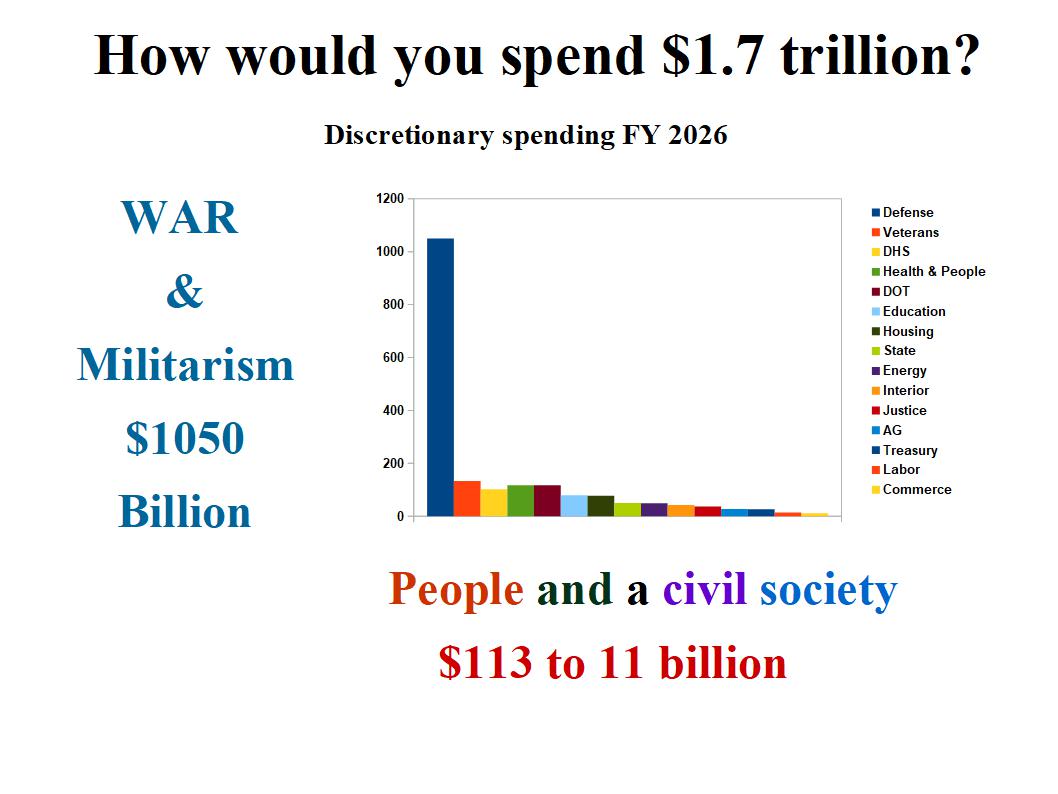
We all know federal spending on war and preparation for war – what we euphemistically call “defense” spending – is huge. But most people have no understanding of how big these numbers are, how they compare with other government spending, and what it all means for their lives.
People might understand $100,000 because that is about the median family income in the U.S. (which means half of families live on less). An average house costs around $400,000. But $7,400,000,000,000 – the total federal budget for FY 2026 – is just a big, incomprehensible number.
Understanding government spending is difficult because of its complexity. Spending is often dispersed across many departments, agencies, programs and often shared with states. So categories of spending (like education, healthcare or science research) can be difficult to calculate accurately. The Department of Defense, for example, pays for K-12 schools, military family healthcare and science research from its base discretionary budget. There is more than weapons and troops in “military” spending.
Another problem is that the budget experts often don’t agree on the numbers or calculate them differently. What goes into a broad category of spending is not standardized. Plus experts often cherry pick the numbers to support a political bias. Liberals talk about military spending as a high percentage of the discretionary budget. Conservatives minimize the size of military spending by using the percentage of total federal spending or the percentage of the overall economy (GDP).
There are three basic parts to federal spending: mandatory spending, discretionary spending, and interest on the debt. Mandatory spending includes obligations that must be paid by law and are not subject to annual Congressional authorization. Discretionary spending is the operational budget that must be authorized annually by Congress and funds most federal government activities. The servicing of the national debt is mandatory spending. The federal government is continuously borrowing money and continuously paying off or paying interest on this debt. In April 2018, I wrote three articles that discuss all this in more detail (Duluth Reader, “Federal Budget 101” Part 1, 2, and 3).
A large part of total federal spending does go to people. Social Security and Medicare are the the biggest federal expenditures and are mandatory spending. But they are government run insurance programs and not the same as regular spending. For all our working lives we have paid “premiums” (actually payroll taxes) for this insurance coverage and are entitled to receive the benefits when the time comes just like with private insurance.
This article is concerned with discretionary spending. Congress has finally passed most FY 2026 spending appropriations. The Congressional Budget Office projects that total federal spending will be $7.4 trillion (23% of GDP). Total revenue is projected to be $5.6 trillion leaving a $1.9 trillion deficit for the year. Discretionary spending is roughly $1.7 trillion. This is a $24 billion increase over FY 2025. Discretionary military spending (including nuclear weapons from DOE and overseas operations not in the base DOD funding) is $1.05 trillion and a 17% increase. Non-defense discretionary spending is expected to be $783 billion with only a 1.1% increase.
Note that the projected budget deficit exceeds all discretionary spending for the year. This is happens frequently. The deficit is largely caused by tax cuts, tax breaks and loopholes. Cutting discretionary spending can not solve budget deficit problems and politicians are not going to collect taxes, so we have deficits.
How is your money being spent? Here are the FY2026 discretionary numbers by department. Note that Congress did not agree with many of Trump’s proposed spending cuts.
Defense (DOD): The base is $961.6 billion. I will use the more inclusive $1.05 trillion for comparisons. Veterans Affairs (VA): $133 billion ($441 billion if mandatory spending is added). Homeland Security (DHS): $102 billion from FY2025 (FY2026 has not been finalized). Health and Human Services (HHS): $116.8 billion. Transportation: $116.5 billion (this doesn’t include roads funded from the gas tax trust fund which is in mandatory spending). Education (DoEd): $79 billion. Housing and Urban Development (HUD): $77.3 billion (a 12.5% increase). State Department: $50 billion ($19 billion more than Trump’s request). Energy (DOE): $49.1 billion with non-defense cut 13%. Nuclear weapons are partially paid for by DOE ($20-25 billion per year), Department of Interior: $42 billion. Justice: $37 billion. Agriculture: $26.6 billion (a 1.3% increase). Treasury: $26.5 billion (with a 9% cut to the IRS). Labor (DOL): $13.7 billion Commerce: $11.1 billion.
Now let’s make these numbers easier to visualize and understand. If we let one inch equal $1 billion, spending on war and preparation for war would be 87.5 feet tall (using the more accurate $1.05 trillion DOD figure). All the other important activities of our government receive much less funding. Even veterans healthcare (which is war related) only receives 11 feet of discretionary funding. Health and Human Services gets 9.7 feet. Education 6.6 feet. The Justice Department – federal courts and prosecutors essential for law enforcement – only 3.1 feet. Agriculture – the home of farm subsidies and food inspections – 2.2 feet. The National Institutes of Health is 4 feet high. Many critical activities like the air traffic controllers, the Center for Disease Control, OSHO, FEMA, EPA, National Science Foundation or National Cancer Institute are better measured in inches.
I think most of us are much more likely to die of cancer than from an attack by Iran. But funding for cancer research is only 6 inches high while the $200 billion recently requested to bomb Iran would be 16.6 feet high (and not included in the DOD numbers above).
The most egregious example of our irrational, counterproductive priorities is the contrast between military spending and funding for diplomacy. The Department of State funding is 4.1 feet – one fourth of the above $200 billion. Diplomacy only gets 3% of discretionary spending. DOD gets 62%.
Budgets are about choices. They are statements about what we value and who we are as a people. After eight decades of our bipartisan leadership making military spending a top priority, it is irrefutable that we value military power above all else.
Our massive, worldwide military establishment is not necessary for defense. It is a choice. We could spend our national resources more wisely. But for eight decades we have been controlled by militaristic thinking and the for-profit “military industrial complex.” We live in a nation addicted to war and the we all suffer the consequences.